

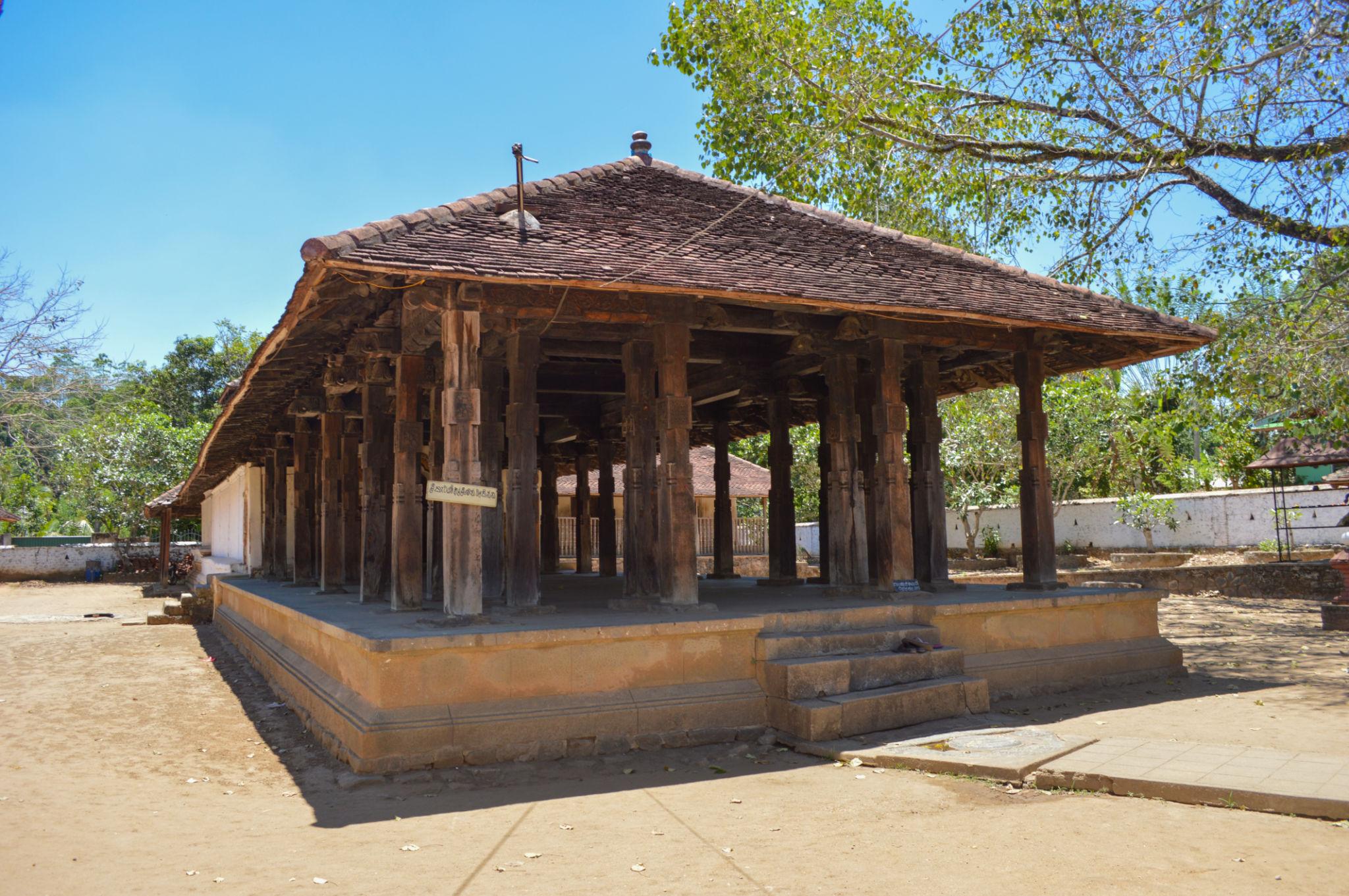
Nestled in the picturesque countryside of Udunuwara, near Gampola in the Kandy District, Embekke Devalaya is one of Sri Lanka’s most remarkable examples of traditional wooden architecture. While the country is internationally renowned for its magnificent stone monuments, ancient stupas and rock fortresses, Embekke Devalaya reveals another extraordinary dimension of Sri Lanka’s architectural heritage: the mastery of timber engineering and intricate wood carving.
What makes this historic shrine particularly fascinating is its traditional construction techniques. Its remarkable wooden framework uses sophisticated interlocking joints to connect structural components, demonstrating the ingenuity of craftsmen who worked centuries before modern construction materials and machinery became available.
How did these wooden structures survive for more than six centuries? What engineering principles allowed the craftsmen to construct such an elaborate timber pavilion? Let us explore the remarkable craftsmanship and architectural secrets of Embekke Devalaya.
1. Historical Background: A Legacy of the Gampola Kingdom
Embekke Devalaya is generally associated with the Gampola Kingdom and the reign of King Vikramabahu III, who ruled between 1357 and 1374 AD.
Historical accounts traditionally attribute its construction to the king, with Delmada Mula Achari recognised in local tradition as the master craftsman responsible for its remarkable wooden artistry.
The temple is also associated with an interesting local legend involving Henakanda Biso Bandara, the queen of King Vikramabahu III, and a drummer named Rangama. According to folklore, a miraculous event connected with Kataragama Deviyo inspired the establishment of the shrine.
Although historical accounts and folklore offer different perspectives on its origins, both contribute to the cultural significance of this remarkable heritage site.
The temple complex comprises three principal sections:
- Wedasitina Maligaya: The principal shrine or sanctum.
- Hevisi Mandapaya: The celebrated drummers’ pavilion, renowned for its extraordinary timber architecture.
- Diggeya: An adjoining ceremonial hall.
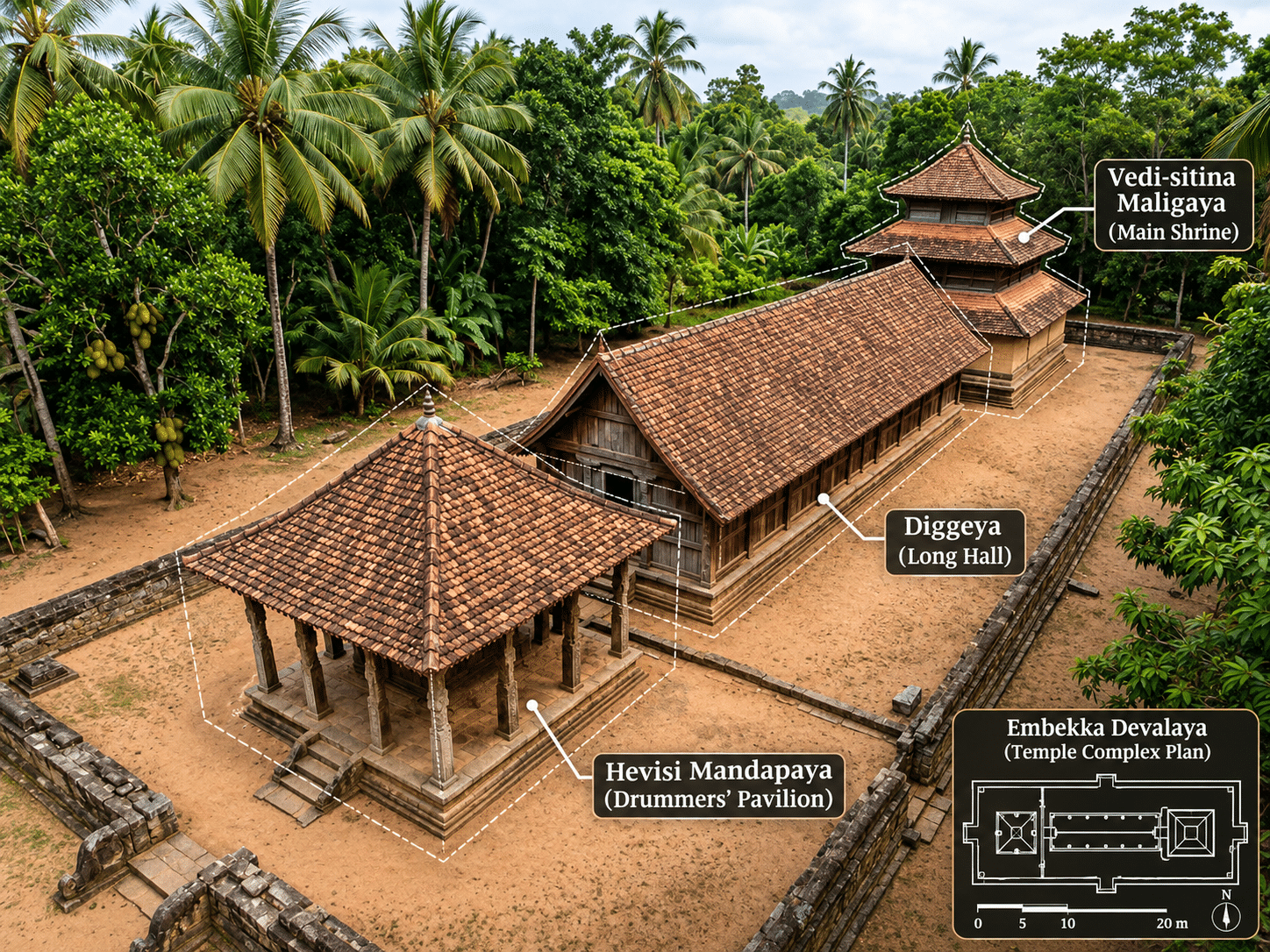
The Hevisi Mandapaya is particularly noteworthy for its impressive arrangement of 32 wooden columns and elaborate decorative elements.
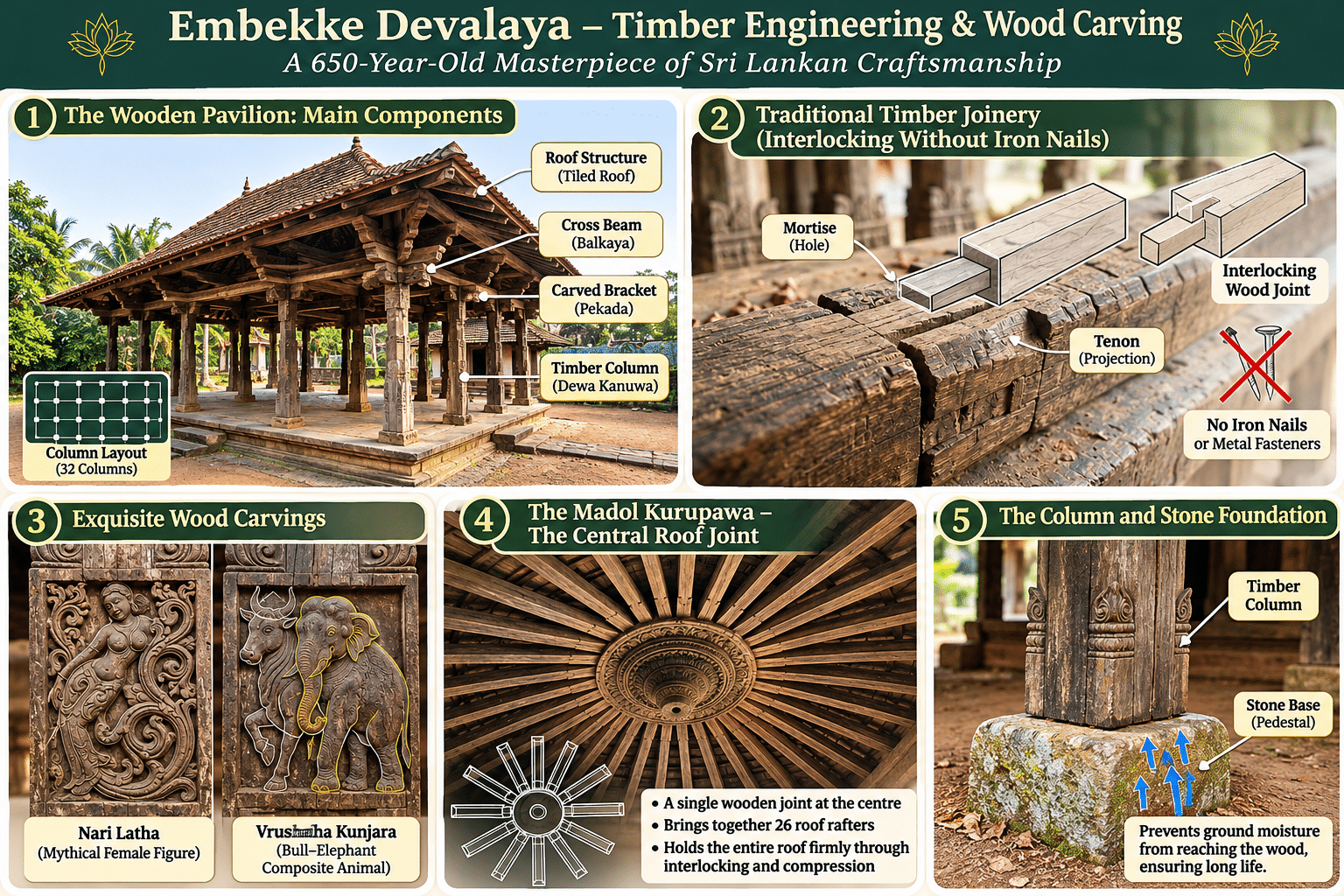
2. The Engineering Secret: Wooden Joints Without Iron Nails
Perhaps the most fascinating feature of Embekke Devalaya is its traditional timber joinery.
Unlike many modern buildings, where timber components are secured using metal nails, bolts and adhesives, traditional craftsmen employed carefully designed wooden connections to join structural members.
One of the principal techniques associated with this construction is the mortise-and-tenon joint, in which a projecting section of one wooden component fits precisely into a corresponding opening in another.
These carefully fitted connections allow different structural elements to work together while maintaining the integrity of the wooden framework.
The traditional approach also avoided some of the problems associated with metal fasteners, including corrosion and the deterioration of surrounding timber.
The Madol Kurupawa: A Masterpiece of Roof Engineering
One of the most remarkable elements of the pavilion’s roof structure is known as the Madol Kurupawa.
This traditional wooden joint is associated with the central arrangement of the roof rafters. According to descriptions of the structure, 26 rafters converge towards a central wooden connection, which helps hold the roof framework together.
Rather than depending on conventional metal fasteners, this arrangement uses carefully shaped timber components and the principles of structural balance, compression and interlocking connections.
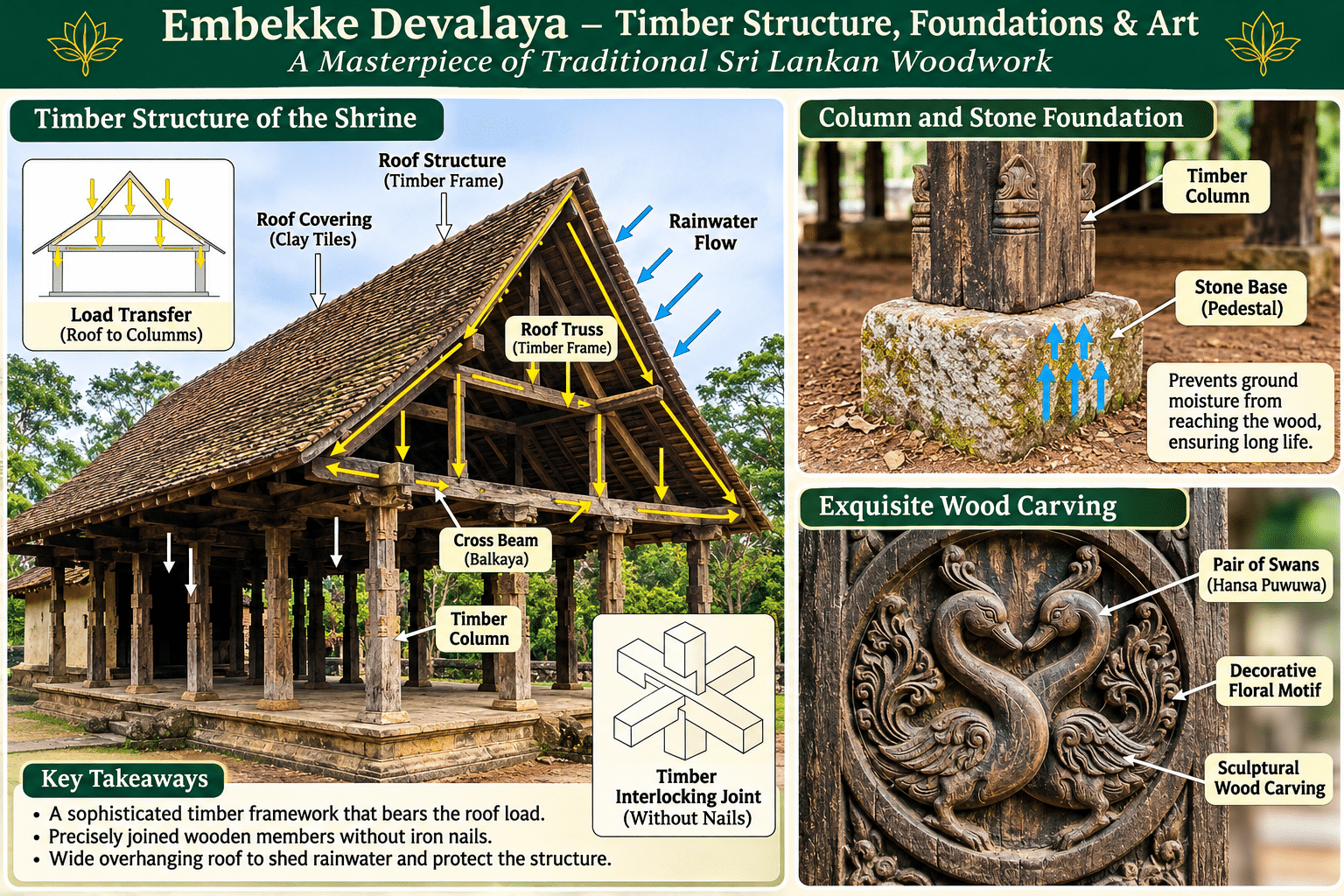
The weight of the roof is transferred through the interconnected wooden members towards the supporting framework.
The ingenuity lies in how the individual components work together as an integrated structure, demonstrating a sophisticated understanding of traditional timber construction.
Pekada: More Than Decorative Wooden Capitals
Another distinctive feature of the pavilion is the beautifully carved wooden capital known as the Pekada.
These decorative elements are positioned between the supporting columns and the horizontal beams.
Although their elaborate lotus-inspired carvings make them visually attractive, they also form an important part of the structural arrangement.
By providing an enlarged supporting surface, the Pekada helps distribute the load from the overhead beams across the supporting column.
This combination of structural purpose and artistic expression is one of the defining characteristics of traditional Sri Lankan architecture.
3. The Science of Timber Selection and Foundation Design
The longevity of traditional wooden structures depends not only on the craftsmanship of their joints but also on the selection and protection of the timber.
Traditional Sri Lankan craftsmen understood the importance of choosing durable timber species suitable for structural applications.
Woods such as Gammalu, Jack, Na and Ebony are among the varieties associated with traditional Sri Lankan woodworking and construction.
Their natural strength, density and durability made them valuable materials for producing structural components and intricate carvings.
Another important feature of the pavilion is the use of stone bases beneath its wooden columns.
By raising the timber supports above ground level, the structure reduces direct exposure to soil moisture, which can accelerate wood decay.
This combination of suitable materials, careful construction and protection against moisture illustrates the practical knowledge developed by traditional craftsmen.
4. A Gallery of Masterpieces: The World-Famous Wood Carvings
While the engineering of Embekke Devalaya is extraordinary, its artistic achievements are equally impressive.
The Hevisi Mandapaya contains an exceptional collection of traditional Sri Lankan wood carvings.
The 32 wooden columns feature intricately carved panels on their four sides, producing a remarkable collection of decorative surfaces. Together with the carved capitals, beams and other structural elements, the pavilion is traditionally associated with more than 500 individual carvings and decorative motifs.
Some of the most fascinating examples include:
Hansa Puttuwa (Intertwined Swans)
This decorative motif features two swans arranged in an intricate interlocking composition. It demonstrates the craftsmen’s ability to transform natural forms into complex geometric and decorative patterns.
Nari Latha
A distinctive ornamental design inspired by a mythical female figure emerging from an elaborate floral composition. It is one of the most recognisable motifs in traditional Sri Lankan decorative art.
Vrushabha Kunjara (Bull-Elephant)
Perhaps one of the most intriguing carvings is the Vrushabha Kunjara, a composition in which the forms of a bull and an elephant are combined within a single artistic arrangement.
Depending on how the viewer interprets the carved lines and shapes, the two animals can be recognised within the same composition.
This remarkable example demonstrates the imagination and technical ability of the craftsmen.
Other Decorative Motifs
The carvings also depict wrestlers, soldiers, dancers, animals, birds and elaborate floral patterns.
These images provide a fascinating glimpse into the artistic imagination, cultural traditions and everyday influences of the period.
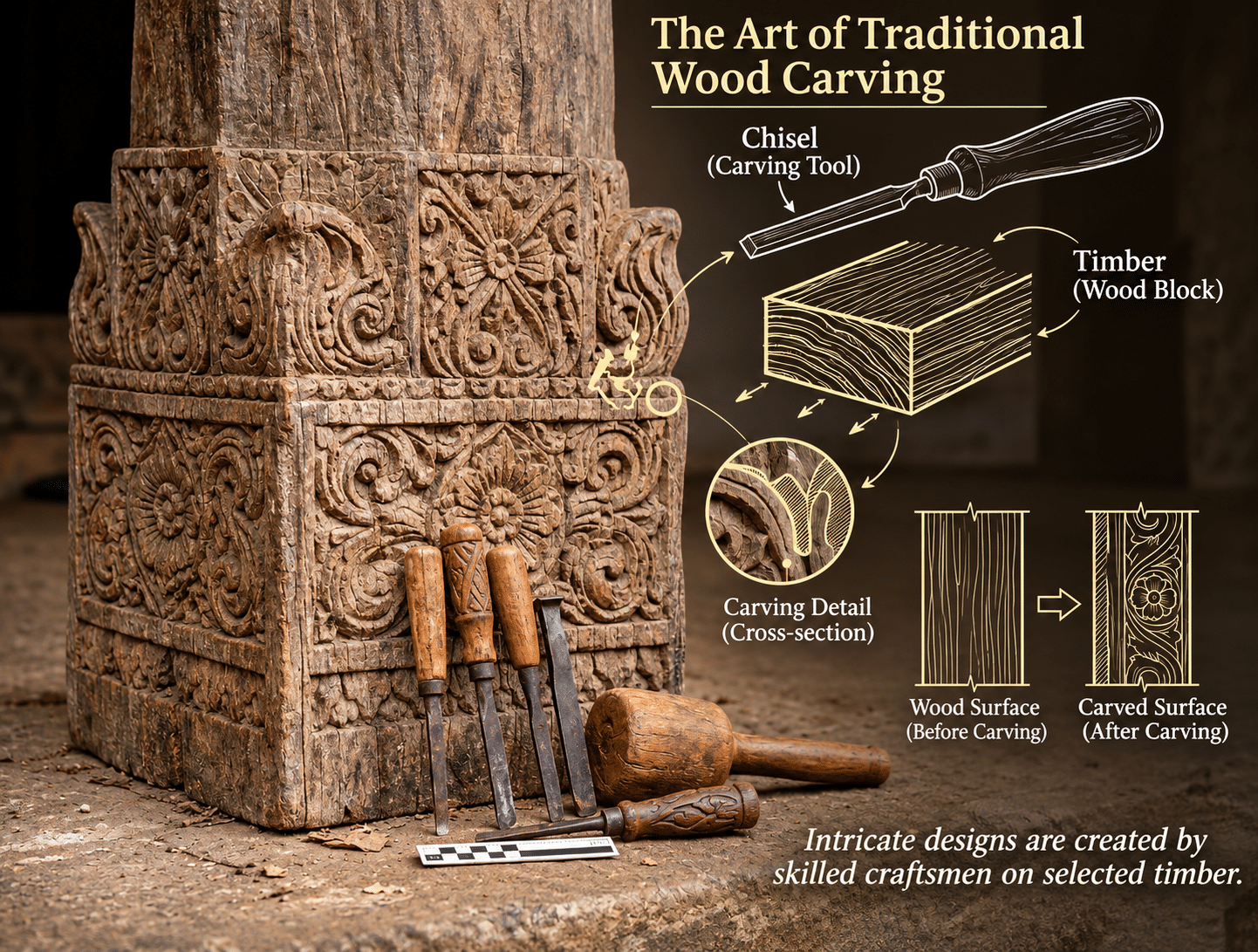
The Art of Hand Carving
What makes these carvings even more remarkable is the craftsmanship involved in producing them.
Without modern power tools or computer-assisted machinery, traditional artisans relied on hand-operated chisels, mallets and other specialised woodworking tools.
Working with dense timber, they produced intricate patterns, fine details and carefully balanced compositions.
The quality of the finished work reflects not only artistic talent but also a high level of technical skill in traditional woodworking and toolmaking.
5. Lessons from Ancient Sri Lankan Sustainable Engineering
Embekke Devalaya is much more than a historic place of worship. It represents an extraordinary combination of architecture, engineering, craftsmanship and environmental awareness.
Its traditional construction offers several lessons that remain relevant even today.
- Material efficiency: Making effective use of locally available timber and traditional building materials.
- Mechanical ingenuity: Using carefully designed wooden joints rather than relying entirely on metal fasteners.
- Structural understanding: Distributing loads through interconnected beams, columns and supporting capitals.
- Environmental awareness: Protecting wooden structures from direct ground moisture through raised stone foundations.
- Artistic integration: Combining structural elements with decorative craftsmanship rather than treating architecture and art as separate disciplines.
The pavilion stands as a testament to the remarkable knowledge possessed by Sri Lanka’s traditional craftsmen.
It reminds us that technological advancement is not measured solely by the sophistication of modern machinery. Sometimes, the greatest achievements come from a deep understanding of natural materials, structural principles and the environment.
6. Visiting Embekke Devalaya
For visitors exploring the cultural heritage of the Kandy region, Embekke Devalaya offers a rewarding experience beyond the more familiar attractions of the city.
Located in the Udunuwara area near Gampola, the temple can be incorporated into a cultural excursion exploring the historic sites of the Gampola Kingdom.
Visitors should allow sufficient time to appreciate the individual carvings, examine the timber connections and observe the architectural details of the Hevisi Mandapaya.
Rather than simply photographing the pavilion, take a closer look at its columns, capitals, beams and roof structure. Each component reveals another aspect of the craftsmanship that makes this site so special.
Embekke Devalaya is a wonderful destination for anyone interested in Sri Lankan history, traditional architecture, ancient engineering, wood carving and cultural heritage.
Conclusion: A Living Monument to Sri Lanka’s Architectural Genius
Standing for centuries as a remarkable example of traditional timber construction, Embekke Devalaya offers a rare opportunity to appreciate the ingenuity of Sri Lanka’s ancient craftsmen.
Its interlocking wooden joints, elaborate roof framework, beautifully carved columns and extraordinary decorative motifs demonstrate how engineering and artistic expression were brought together in a single architectural masterpiece.
At a time when modern construction increasingly depends on industrial materials and advanced machinery, Embekke reminds us of the remarkable possibilities that can be achieved through craftsmanship, creativity and a profound understanding of nature.
The next time you visit Kandy, make time to discover Embekke Devalaya. You may find that one of Sri Lanka’s greatest architectural treasures is not made of stone, but of wood.
Image and Content Acknowledgement
This article was developed with reference to an educational Facebook publication by Dinusha Nilan, which explores the architectural features, traditional timber joinery and wood-carving techniques of Embekke Devalaya.
The accompanying illustrative images are based on the visual themes presented in the original publication, with English-language adaptations prepared for international readers.
Original source: Dinusha Nilan’s Facebook publication
Note: Historical interpretations, traditional accounts and technical explanations have been presented for educational purposes. Some construction details and numerical descriptions are based on the original source material and traditional accounts.
#EmbekkeDevalaya #SriLankaHeritage #AncientEngineering #WoodCarving #TraditionalArchitecture #Kandy #GampolaKingdom #SriLankaTravel #VisitSriLanka #CulturalHeritage

Comment (0)