

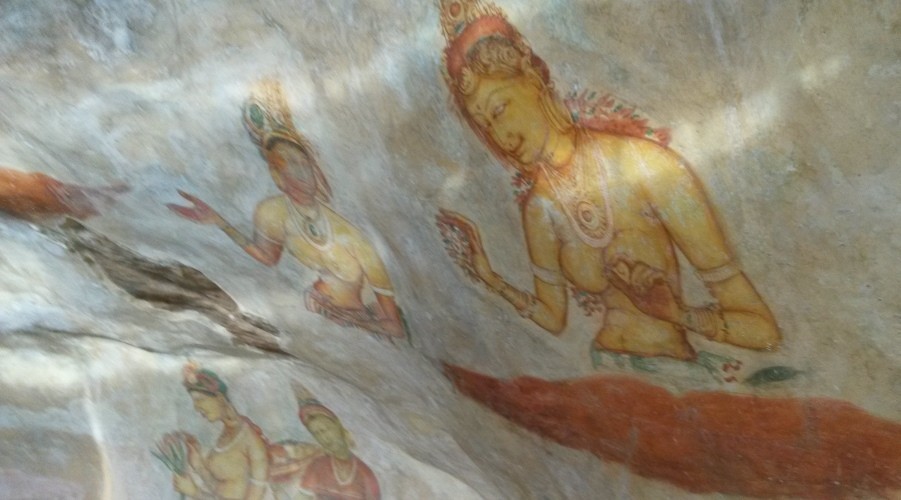
High on the western face of Sigiriya Rock, painted figures emerge from a sheltered recess in the stone. Their colours and flowing lines have captivated visitors for centuries. The paintings date to the fifth century, when King Kassapa I made Sigiriya his capital, and the ancient city became a UNESCO World Heritage Site in 1982. UNESCO: Ancient City of Sigiriya
How did these celebrated images survive so long? The answer is likely a combination of skilled preparation, mineral pigments, a binding medium and a naturally protected location. Some details of the original materials and methods remain under study, so popular claims about exact recipes should be treated with care.
A carefully prepared surface
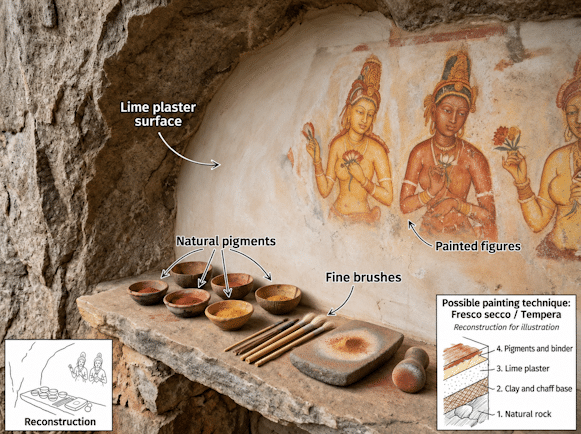
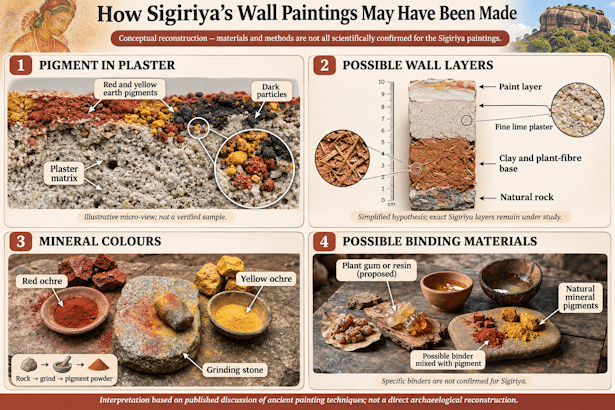
The artists did not simply paint directly onto bare rock. Ancient wall paintings were generally created on prepared surfaces, and Sri Lankan art historian Jagath Weerasinghe describes early Sinhalese painting as using lime and mud with vegetable matter in the rendering. The precise layers and ingredients used for the Sigiriya paintings, however, are not fully settled. Jagath Weerasinghe, Painting Technology and Techniques of Conservation
You may come across detailed accounts listing rice husks, straw, plant fibres, kaolin and lime in specific layers. These are plausible materials in traditional plastering, but the exact Sigiriya recipe should not be presented as proven unless supported by a specific archaeological analysis.
Pigments and painting technique
Research on early Sri Lankan paintings describes a palette that included red earth, yellow, green and black pigments. These colours could be made from mineral and earth-based materials, though the precise composition of every pigment at Sigiriya is not confirmed in the available evidence. Weerasinghe, Painting Technology and Techniques of Conservation
The paintings are often called “frescoes,” but the technical term is debated. In true buon fresco, pigments are applied to wet lime plaster. In secco or tempera methods, pigments are applied to a dry surface with a binding medium. Weerasinghe notes evidence for a binding medium in the Sigiriya paintings, which points towards a secco technique, while also stressing that questions about the paintings’ exact method remain. Weerasinghe, Painting Technology and Techniques of Conservation
So, while the artists’ knowledge of materials was clearly sophisticated, claims that they definitely used honey, egg white or tree resins as binders need qualification: the exact ingredients are not conclusively established.
The importance of the sheltered rock recess
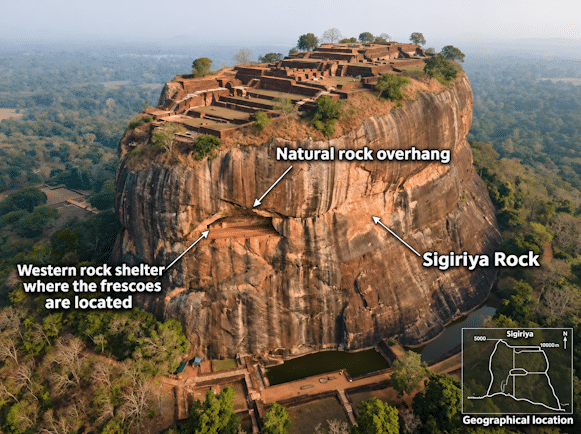
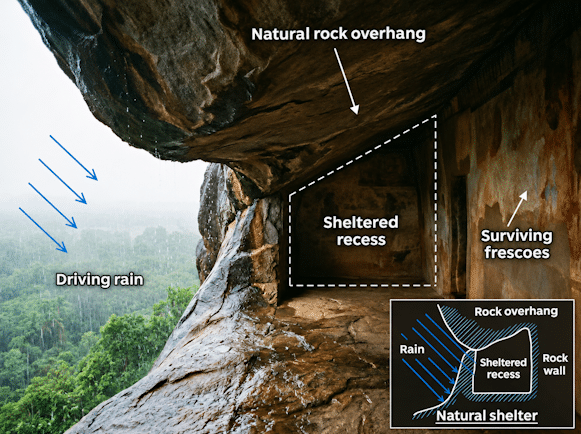
The surviving paintings sit in a recess on Sigiriya’s western face. Their sheltered position helped shield them from direct exposure to rain and sun—a likely part of their long survival. Yet the paintings have not been untouched by time or weather. UNESCO has documented gradual deterioration, including discolouration and pale surface deposits, and called for scientific study and environmental monitoring to guide conservation. UNESCO: Conservation of wall paintings at Sigiriya
This means their preservation is not simply a story of ancient materials resisting the elements. Their location offered protection, and modern conservation remains important.
Who are the women in the paintings?
The figures’ identities are still debated. Archaeologist H.C.P. Bell proposed that they represented women from King Kassapa’s court. Ananda Coomaraswamy suggested they were apsaras, or celestial beings. Senarath Paranavithana interpreted them as personifications of lightning and clouds associated with the mythical city of Alakamanda. There is no definitive consensus. MAP Academy: Sigiriya Murals and Mirror Wall
The paintings once formed part of a much larger mural. Only a small number of figures survive today, making their expressive gestures, jewellery and vivid colours all the more remarkable. MAP Academy
The Mirror Wall: a record of early visitors
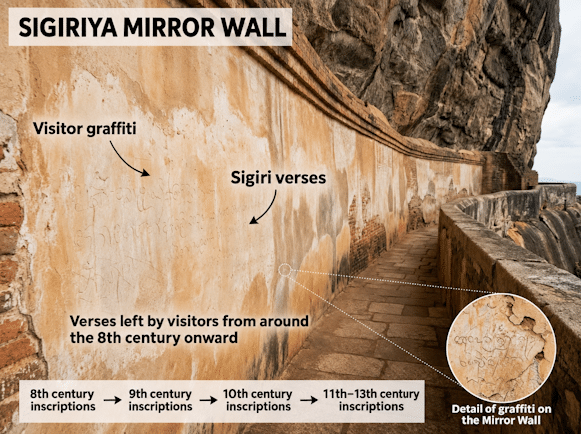
Below the paintings, the polished Mirror Wall carries verses and inscriptions left by visitors over many centuries. These writings show that people came to Sigiriya and responded to the figures long after the royal city’s heyday. The inscriptions are an important record of early Sinhala literary culture as well as a moving trace of individual visitors’ impressions. MAP Academy
A legacy of art, knowledge and care
The Sigiriya frescoes have endured through a fortunate combination of artistic skill, prepared surfaces, pigments and a sheltered setting. Their story also reminds us that conservation is ongoing: even celebrated heritage sites need careful monitoring and protection.
For visitors to Sri Lanka, seeing the frescoes is a chance to encounter not only a masterpiece of ancient painting, but also a place that inspired generations of people to stop, look and leave their words on the wall.
Visiting Sigiriya? Follow site guidance, avoid touching historic surfaces, and help protect the paintings for future visitors.
Editorial note: The exact plaster recipe, pigment sources and binding ingredients remain subjects of research. Avoid presenting specific recipes as established fact without a supporting study.

Comment (0)