

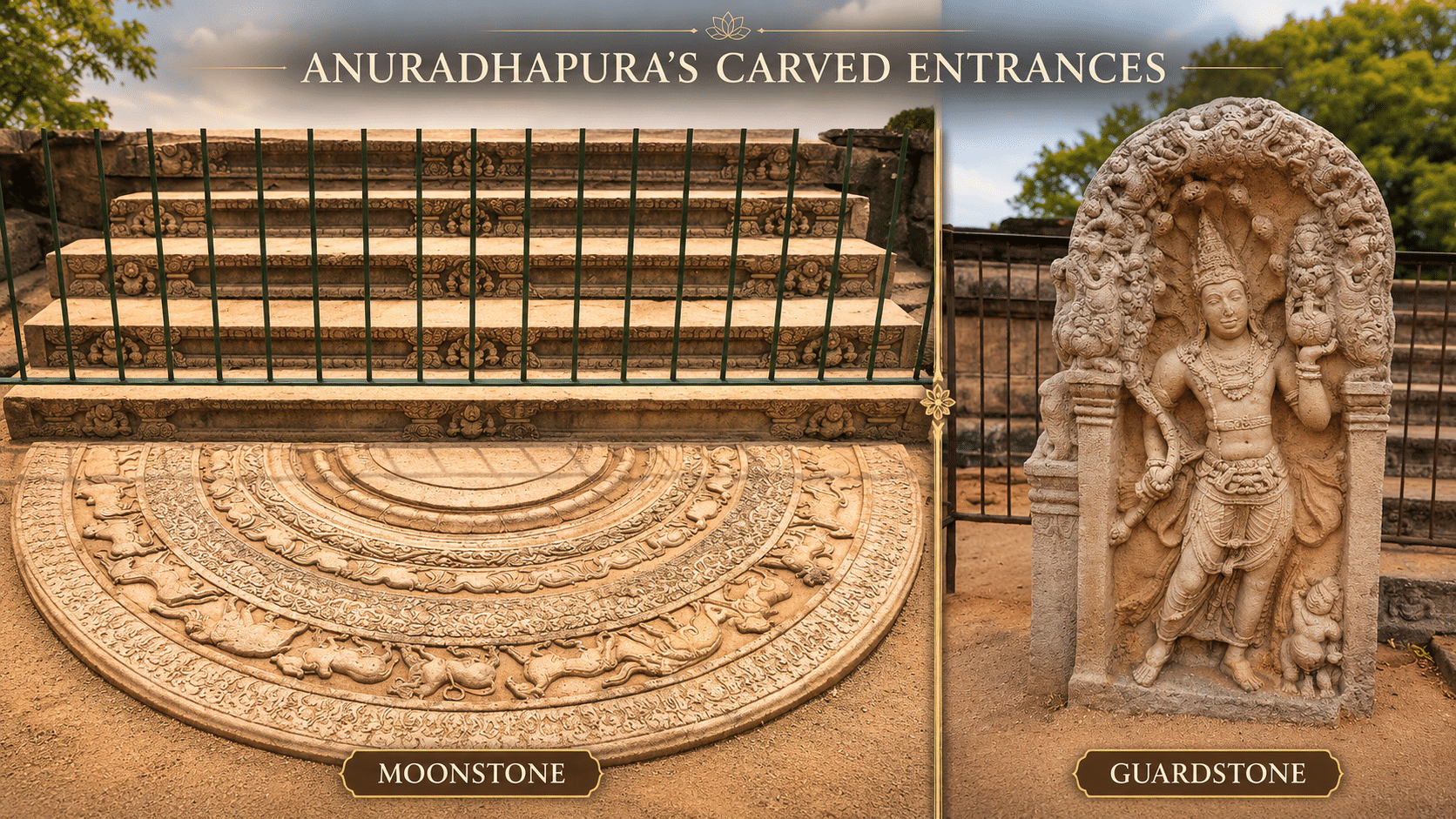
The Sandakada Pahana (moonstone) and Muragala (guardstone) are two of ancient Sri Lanka’s most distinctive carved entrance features. At Abhayagiriya in Anuradhapura, they reveal how skilled stoneworkers combined architecture, design and religious imagery. This guide explores how the Abhayagiriya moonstone and guardstone were made, what archaeological evidence tells us about their materials and tools, and how Anuradhapura moonstones compare with those at Polonnaruwa.
What are the moonstone and guardstone?
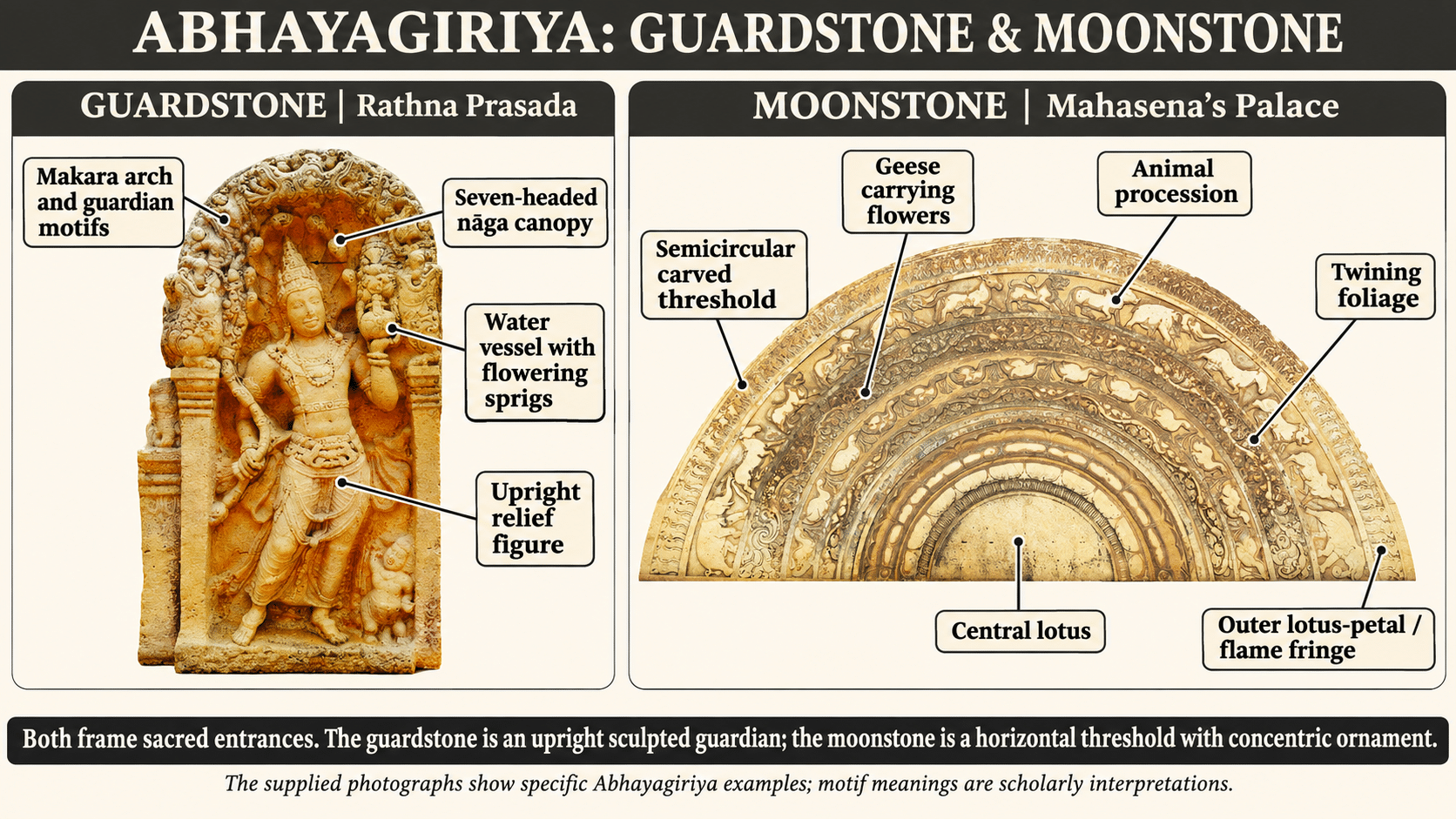
A moonstone is a semicircular carved slab set at a doorway or at the foot of a staircase. A guardstone stands upright beside an entrance, commonly as one of a pair, beyond the threshold. Together with carved balustrades, these stones form a sculptural entrance arrangement. The Abhayagiriya complex preserves moonstones at Mahasena’s Palace and the Queen’s Pavilion; a famous guardstone associated with the Ratnaprasadaya depicts a nāga king with a serpent hood, flowers and a pot of abundance.
Choosing and preparing the stone
Ancient Anuradhapura builders had access to local gneiss bedrock. A study of stone resources in the city found that local gneisses supplied much building material, while some marble used for ornamentation was brought from farther away. This regional evidence does not identify the precise quarry or stone type used for each Abhayagiriya carving.
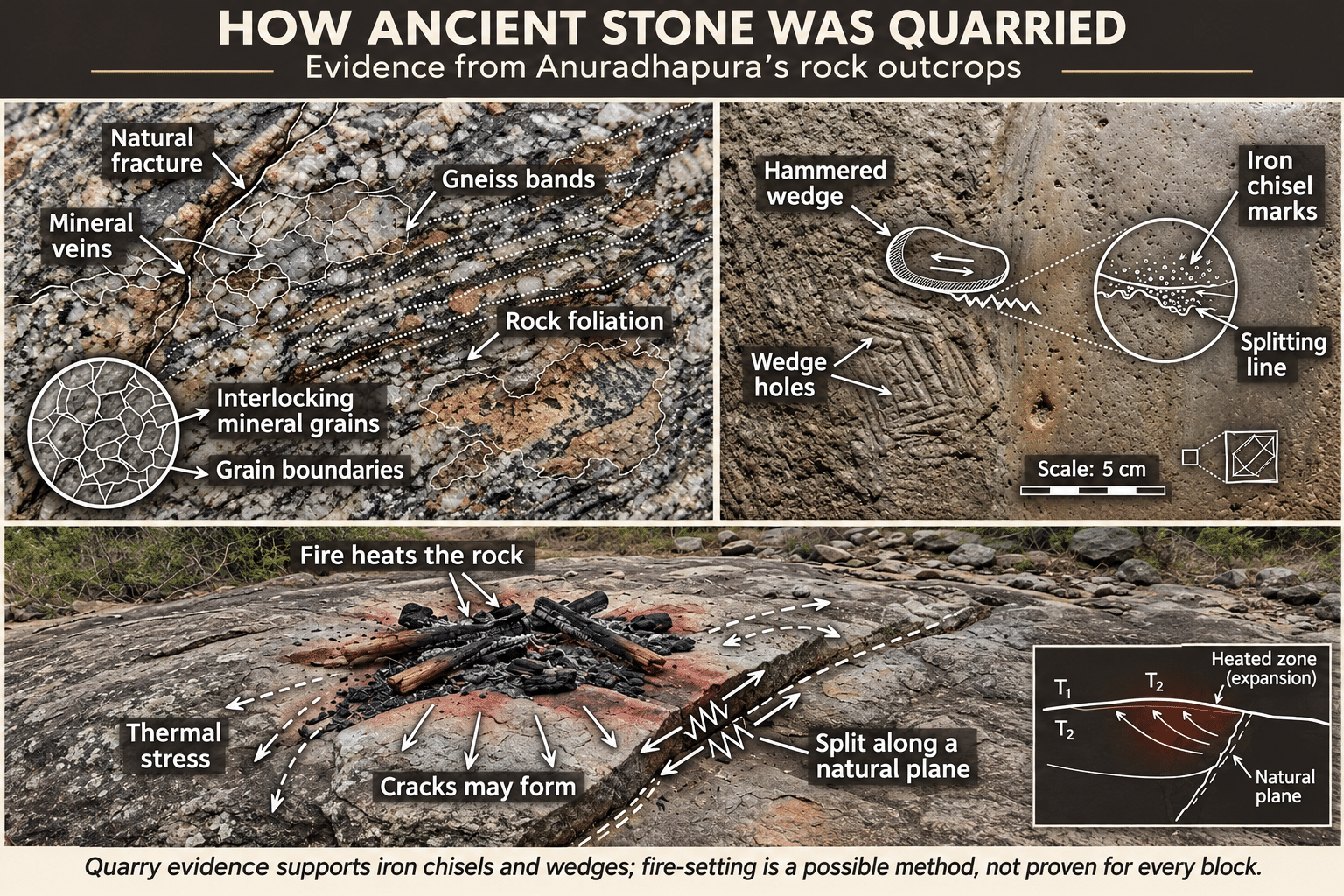
Quarry marks around Anuradhapura provide evidence for a controlled method of splitting stone. Craftspeople made a line of holes with iron chisels, placed wedges into them, and struck the wedges with hammers. The pressure could create a fracture that separated a block from the parent rock. Workers also took advantage of natural joints and fractures where possible. The study found no field evidence for stone sawing in the surveyed quarries. Fire-setting is discussed as a possible quarrying technique, but it should not be presented as proven for every block or for these particular sculptures. Read the Anuradhapura stone-resource and quarrying study.
Planning and carving the designs
The moonstone’s semicircular shape and repeated concentric bands required deliberate layout. The finished design places a central lotus within curved decorative zones, but available sources do not establish exactly how Abhayagiriya craftsmen measured or marked those arcs. A compass-like divider or cord is a possible reconstruction, not a documented fact.
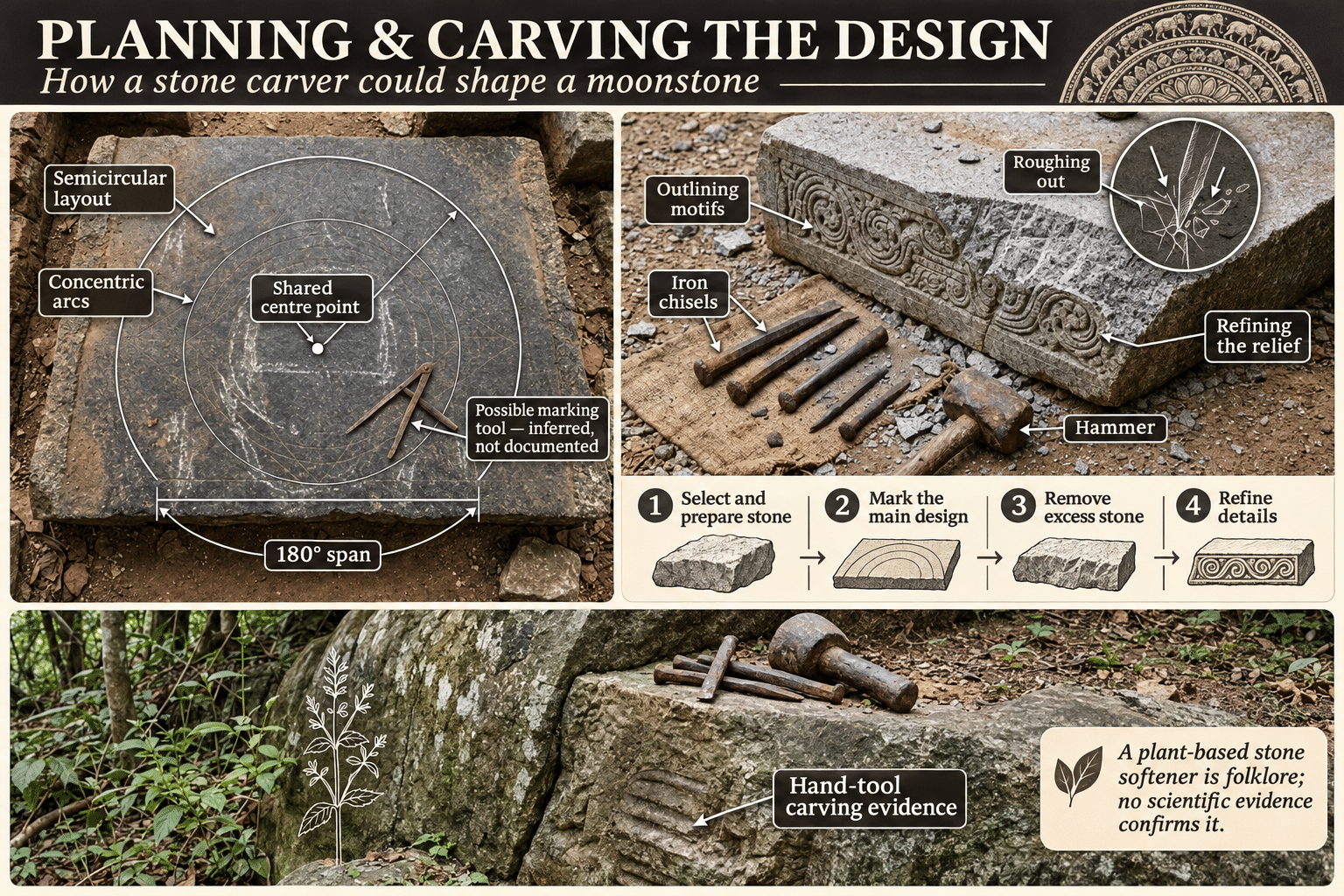
The relief carving also required careful control. The artisan had to preserve the stone needed for each motif while lowering the surrounding surface. A reasonable reconstruction is that the block was prepared, the main design laid out, excess stone removed, and details refined with hand tools. Archaeological quarry evidence supports iron chisels, wedges and hammers for working stone, but it does not document every tool or step used on the moonstone and guardstone themselves.
Sri Lanka’s ancient iron and steel production, including wind-driven smelting furnaces at Samanalawewa, provides important context for the island’s metalworking history. It does not prove that a specific steel alloy or *wootz* chisel was used to carve these monuments. Read the research on Sri Lankan iron-smelting technology.
How have the carvings endured?
The surviving carvings owe their endurance to durable stone, skilled workmanship and the circumstances in which the monuments were preserved. Stone surfaces still weather and wear; survival does not mean they have remained unchanged. Abhayagiriya itself developed over many centuries, with buildings using stone alongside brick, timber and other materials. The available sources do not verify a special polishing process for these particular carvings, so claims about quartz or corundum polishing should be treated cautiously.
Anuradhapura and Polonnaruwa moonstones compared
Moonstones in both ancient capitals share a semicircular form and concentric decorative bands. In characteristic Anuradhapura examples, a central lotus is surrounded by bands that commonly include geese, foliage, a procession of four animals—elephant, lion, horse and bull—and an outer band of flames.
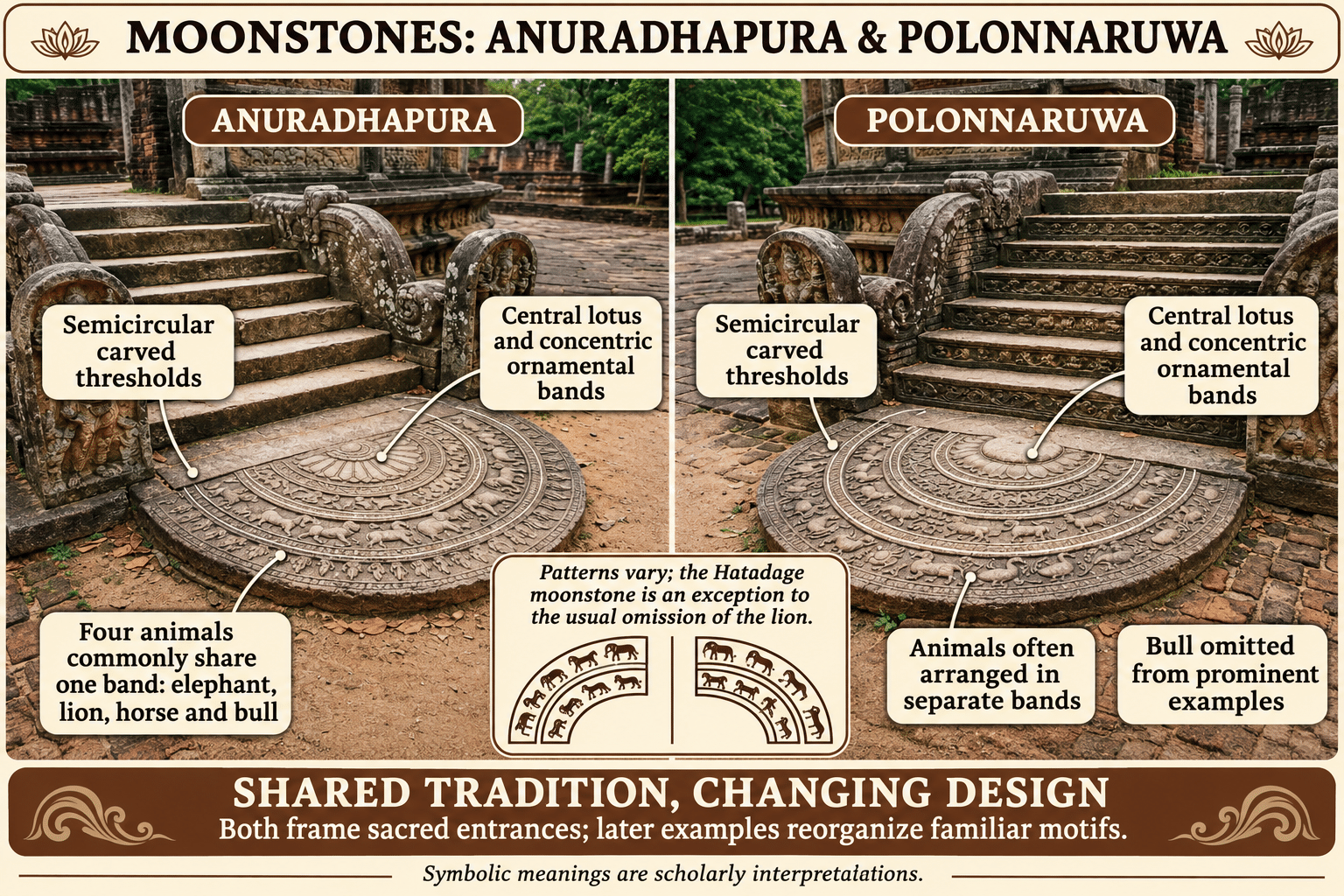
In prominent Polonnaruwa examples, the animals are often arranged in separate bands and the bull is omitted. The Central Cultural Fund links the omission to Hindu traditions, in which the ox is sacred. The lion is also often absent, though there are exceptions, including the Hatadage moonstone. These are characteristic patterns, not rules for every example. Central Cultural Fund: Polonnaruwa; Sunday Times: moonstone design and interpretations.
The comparison shows continuity as well as change: both traditions retain the threshold’s curved form and layered ornament, while Polonnaruwa carvers reorganized familiar motifs. The meaning of the designs remains a matter of scholarly interpretation rather than a message explicitly recorded on the stones.
Sources and further reading
- Impart, “Abhayagiri Vihara, Anuradhapura” — the complex, its moonstones and the Ratnaprasadaya guardstone.
- Wagalawatta, “Management & Functional Use of Mineral Resources in Ancient Sri Lanka” — local stone resources and quarrying evidence.
- Central Cultural Fund, Polonnaruwa — the change in moonstone motifs.
- Sunday Times, “The Sandakadapahana or the moonstone” — design descriptions and interpretations.
- Juleff et al., “Computational simulation of air flows through a Sri Lankan wind-driven furnace” — context on ancient iron production.

Comment (0)