

The first thing you notice on the Horton Plains trail is the air. It is cool, the grasslands are still silver with mist, and the cloud forest seems to gather at the edge of the path. Then the plateau opens, the valley drops away, and you arrive at World’s End: one of Sri Lanka’s most memorable highland viewpoints.
This is a hike of changing scenery as much as distance. Over a roughly 9 km circular trail, you cross open patana grassland, enter mossy montane forest, pause at Little World’s End and the main escarpment, then follow the sound of water to Baker’s Falls. Allow about 3–4 hours at a comfortable pace, with extra time for photographs, birdwatching and rest stops.
When to hike for the World’s End view
Start as early as you can. The morning often brings the best chance of seeing the panorama before cloud and mist drift over the escarpment. Sri Lanka Tourism recommends visiting between 6:00 and 10:00 a.m.; the clearest months are generally January to March, although mountain weather can change at any time. An early start also gives you a quieter walk through the grassland and forest.
For the best chance of an open view, plan to begin the loop soon after reaching the park and aim to arrive at World’s End in the early part of the morning. The sample schedule below is a guide, not a fixed timetable: walking speed, stops, weather and park entry arrangements will affect your pace.
A sample morning on the 9 km Horton Plains trail
| Approximate time | Trail moment |
|---|---|
| 6:00–6:30 a.m. | Arrive, prepare for the walk and set out from the visitor area. |
| 6:30–7:15 a.m. | Cross the open patana grassland as the light lifts over the plateau. |
| 7:15–7:45 a.m. | Pause at Little World’s End, a smaller lookout over the valley. |
| 7:45–8:30 a.m. | Continue to World’s End for the main escarpment panorama, weather permitting. |
| 8:30–9:30 a.m. | Walk back through the forest section toward Baker’s Falls. Take care on wet steps and rocks. |
| 9:30–10:30 a.m. | Enjoy a short stop at the falls, then complete the loop back to the visitor area. |

Grassland, cloud forest and a sudden horizon
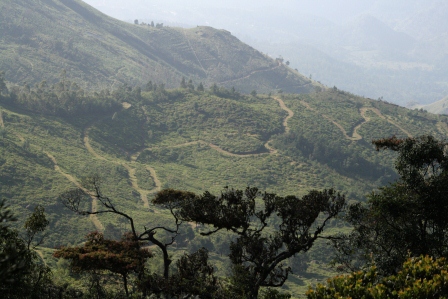
The trail begins among highland grasslands known as patana. Look closely and you will see more than a wide green plain: tussock grasses, small flowering plants and shrubs survive in a cool, windswept climate. Sambar deer sometimes graze along the open edges, so keep your distance and watch quietly.
As the path enters cloud forest, the scenery changes. Moss and lichens cover branches, ferns line the damp ground, and the canopy feels close overhead. Listen for birds in the undergrowth. Horton Plains is home to highland species including the Sri Lanka white-eye, yellow-eared bulbul and dull-blue flycatcher. You may hear movement long before you spot its source.
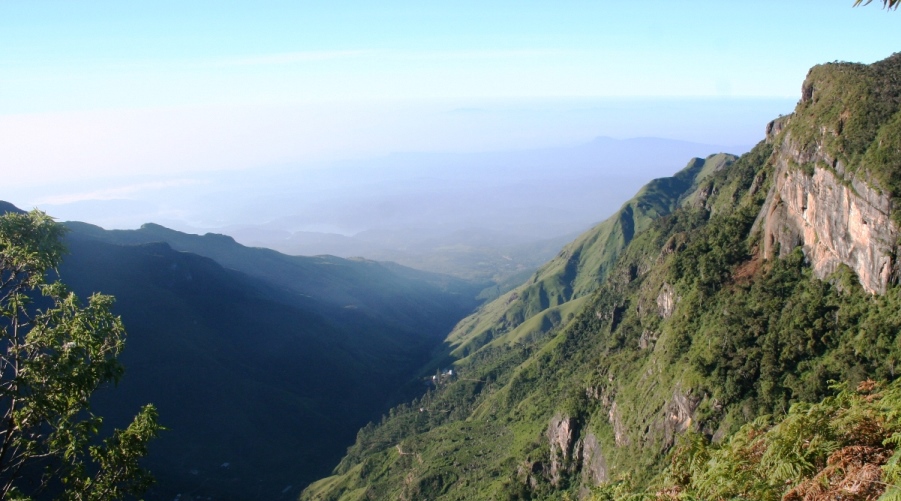
Then the forest thins and the land seems to end. At World’s End, the plateau breaks into a steep escarpment above the southern lowlands. On a clear morning, the view stretches far across valleys and hills; when the mist rolls in, the edge disappears behind a shifting white curtain. Either way, give yourself a moment to take in the scale of the landscape—and stay behind the safety barriers.

Baker’s Falls: the forest’s cool finale
After the escarpment, the route curves back through forest toward Baker’s Falls. The sound of falling water is a welcome change from the open plateau. The descent to the viewing area includes steps and can be slippery, especially after rain, so use care and take your time. From the waterfall, the trail returns through grassland and forest to complete the circular walk.

A story from the old hunting days
As you walk, it is easy to imagine how different these plains once felt to visitors. The name Horton Plains recalls the nineteenth-century colonial period, when the highlands were used for hunting. A story told about Captain William Rogers, a famous hunter, says lightning struck his grave after his death—as though the landscape itself had passed judgment. It is a memorable local tale, best understood as folklore rather than verified history. Today the park is valued for its wildlife and fragile habitats, and the best way to enjoy it is to leave no trace.
What to bring and how to walk gently
- Wear sturdy shoes with good grip; parts of the trail can be muddy or slippery.
- Pack a warm layer and rain protection. The highland weather can shift quickly.
- Bring water, sun protection and a small snack for the walk.
- Stay on marked paths and well back from the escarpment edge.
- Keep a respectful distance from wildlife, and take all rubbish back with you.
- Check current entry arrangements and park guidance before travelling.
Horton Plains rewards an early start: the cool air, quiet trail and chance of a clear view make the effort worthwhile. The loop is about 9 km and usually takes 3–4 hours, but leave room in your morning to stop, look and listen. For more details about the park’s highlights and visitor tips, see our Horton Plains National Park Attraction guide.
Explore more: Horton Plains flora and fauna guide · Horton Plains National Park Attraction guide.

Comment (1)